
Camera Sensor Size Chart & Comparison
Comparing camera sensor sizes can feel like a total minefield — but fear not, photography friends. In this guide, we’ll clearly explain camera sensor size differences and include an easy-to-use camera sensor size chart you can download and refer back to anytime.
Should you choose full frame, APS-C, or Micro Four Thirds? What real-world visual differences do different camera sensor sizes create? Do you need different lenses for different sensors, and how does a camera sensor size comparison actually help when choosing a camera?
By the end of this article, you’ll understand exactly how camera sensor sizes work and how to use a sensor size chart to confidently choose the right setup for your photography.
Get access to all our online photography courses — including in-depth lessons on camera sensors, lenses, and focal length — with our monthly membership.
What Is a Camera Sensor? Understanding Sensor Sizes & Charts
Let’s keep this simple.
A camera sensor is the part of the camera that captures light and turns it into an image. In the past, this role was performed by photographic film. Today, it’s handled by a digital chip known as the camera sensor.
Understanding how a camera sensor works is essential before using a camera sensor size chart, because all sensor size comparisons are based on how much light the sensor can physically capture.
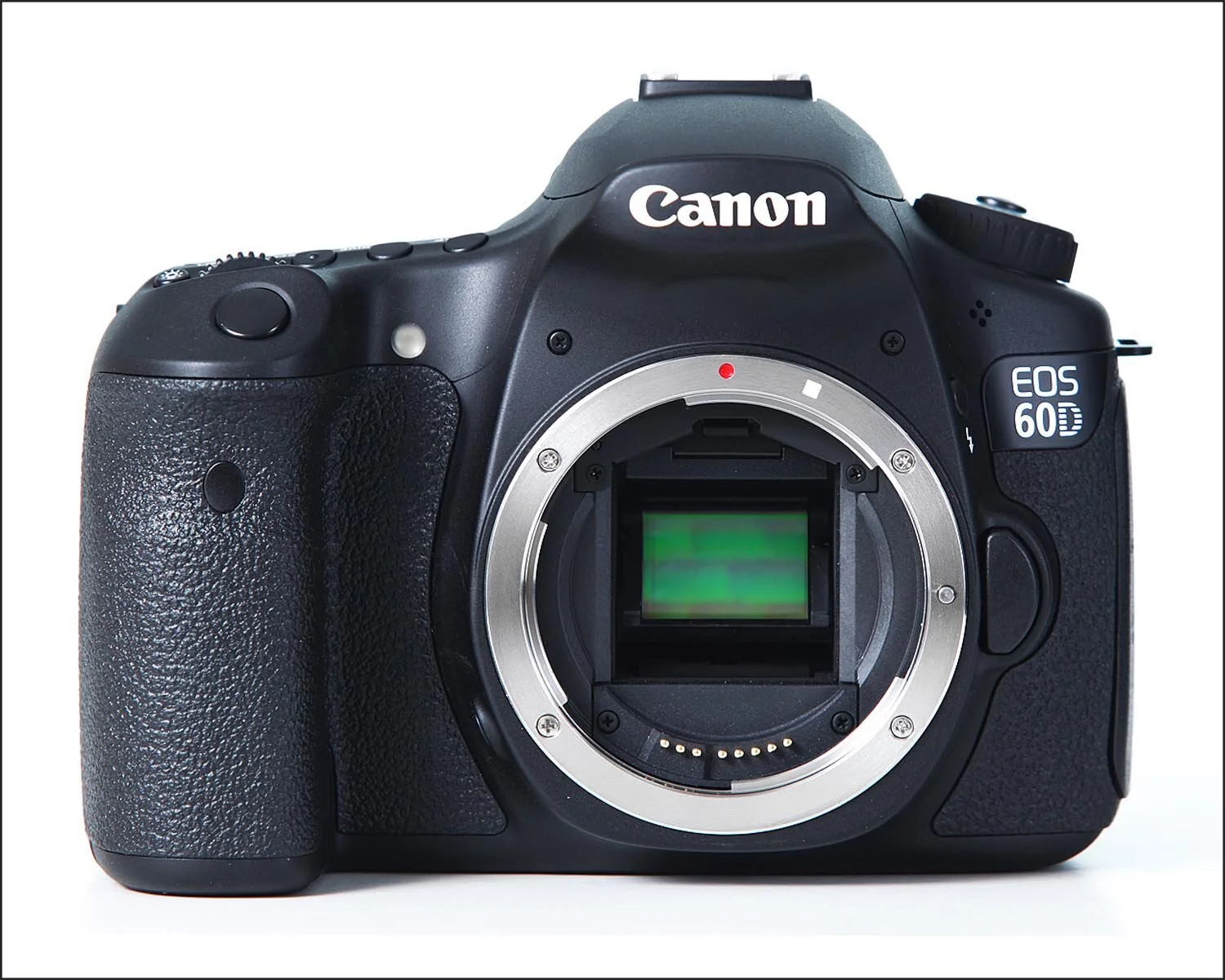
The camera sensor sits behind the lens and captures light to create the final image.
Why Are There Different Camera Sensor Sizes?
There are three main camera sensor sizes commonly used today. These are shown clearly in any standard camera sensor size chart and are listed below from largest to smallest:
Full Frame Sensor – approximately 35mm across its longest edge, based on the dimensions of 35mm film
APS-C Sensor (Crop Sensor) – approximately 22mm across its longest edge
Micro Four Thirds Sensor – approximately 17mm across its longest edge
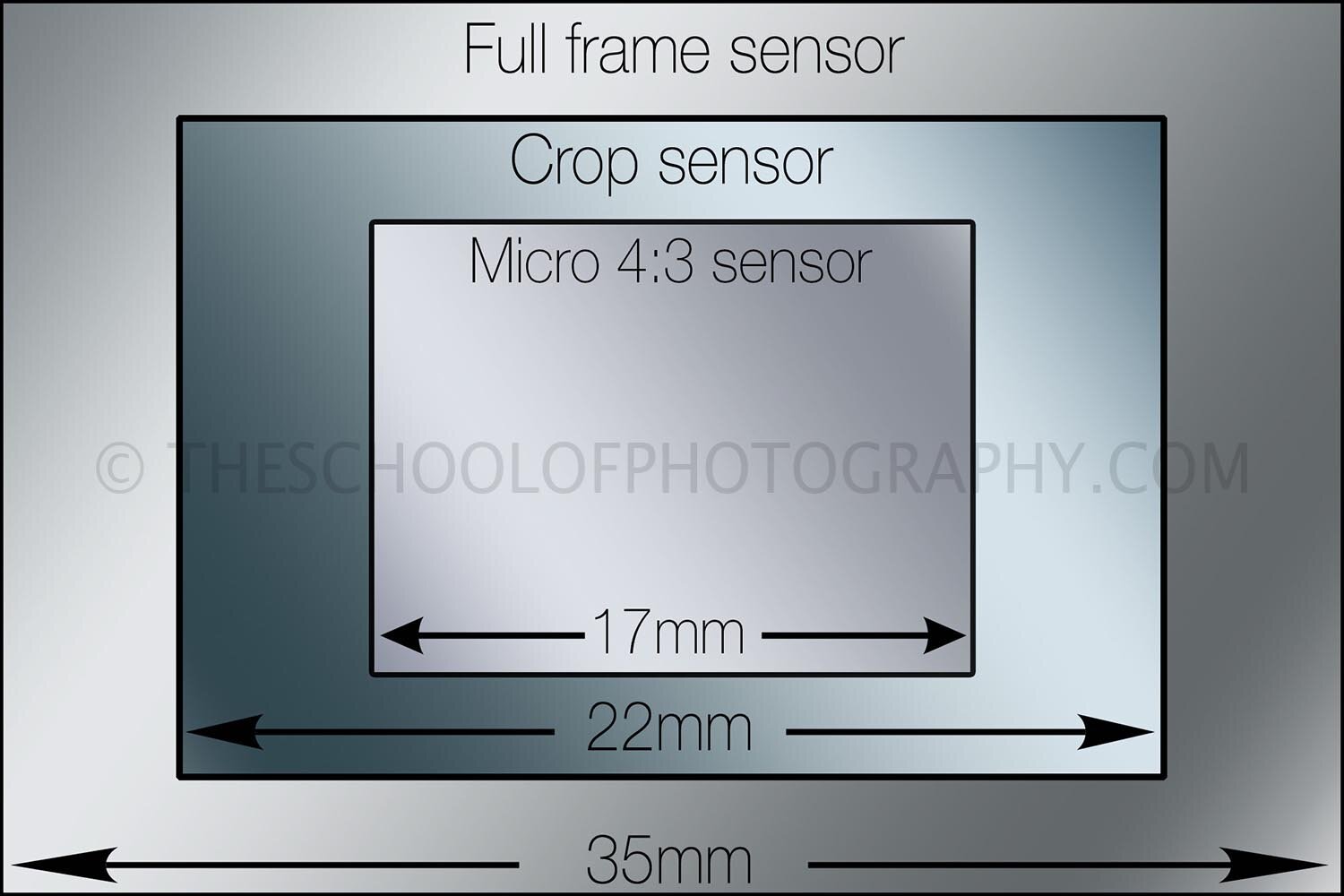
Camera sensor size comparison chart illustrating the relative sizes of full frame, APS-C (crop), and Micro Four Thirds sensors.
The main difference between a Micro Four Thirds sensor, a crop sensor (APS-C), and a full frame sensor is physical size. In general, the larger the camera sensor, the more light it can capture and the more image data is recorded. Larger sensors also tend to require bigger camera bodies, and full frame cameras are usually the most expensive.
There are two main reasons camera manufacturers produce different sensor sizes. The first is cost. Smaller sensors are less expensive to manufacture, which allows camera companies to offer more affordable cameras — an important factor when deciding which camera to buy.
The second reason is size and weight. Full frame cameras are typically larger and heavier, while APS-C and Micro Four Thirds systems are designed to be more compact. Choosing a smaller sensor doesn’t just reduce the size of the camera body — lenses and accessories are also smaller and lighter. In real-world use, there can be a significant difference in overall kit size and weight between a full frame system with multiple lenses and a Micro Four Thirds setup with the same number of lenses.
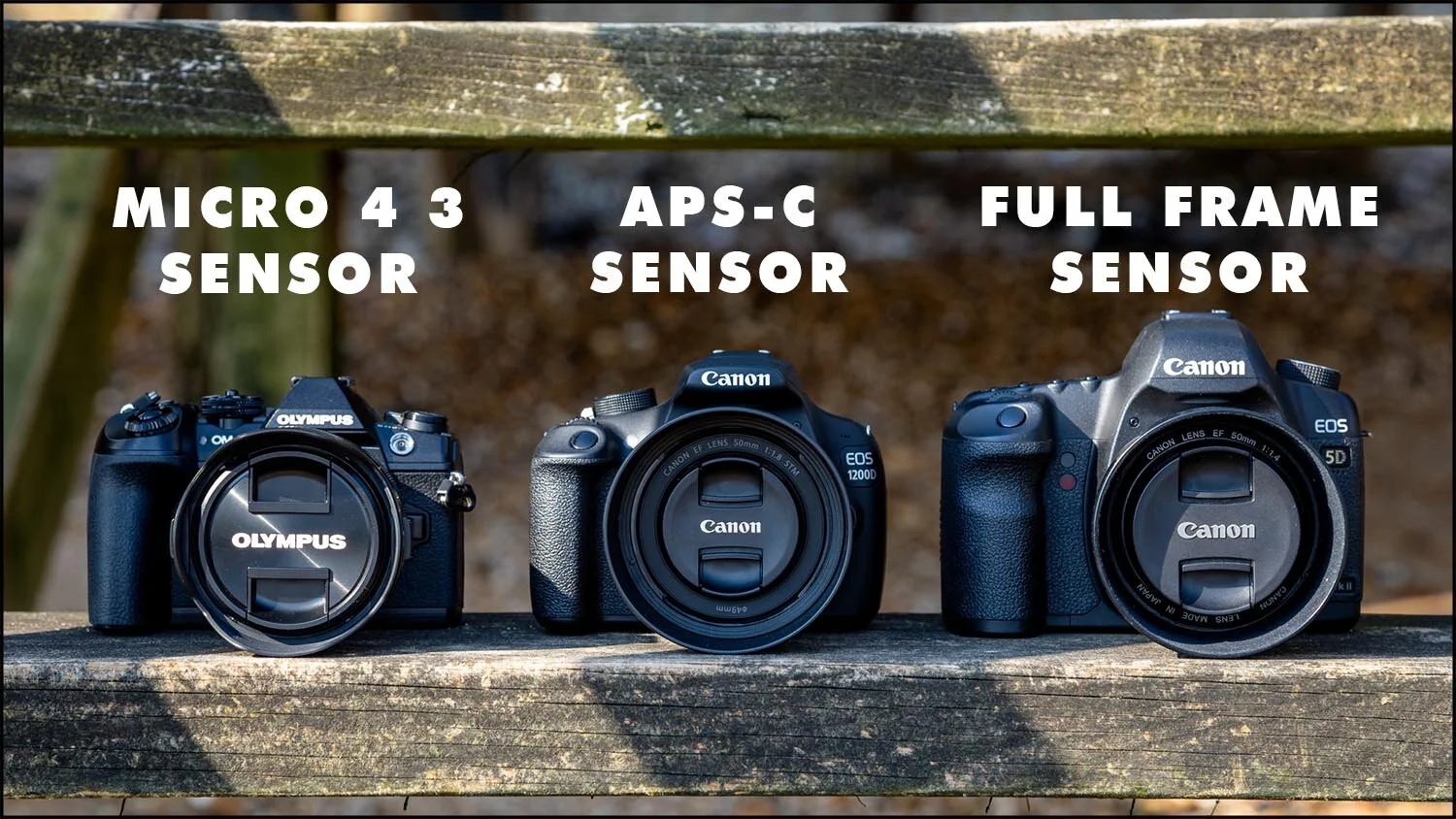
Three cameras using different sensor sizes: Micro Four Thirds, APS-C (crop sensor), and full frame.
Want 10% off your first course? Click here
Camera Sensor Size Comparison and Lenses
This is where a lot of confusion tends to arise, so let’s keep it simple.
A camera’s sensor size does not change the lens itself — instead, it affects how the focal length appears. Focal length determines how zoomed in or out your image looks, also known as the angle of view. (If you’d like a deeper explanation of focal length, you can explore it here.)
When you use the same focal length on cameras with different sensor sizes, you’ll see very different visual results. This is because each sensor captures a different portion of the image projected by the lens.
In the video below, I demonstrate this with a real-world camera sensor size comparison. Each photo is taken from the same position, using the same focal length (35mm), but on cameras with different sensor sizes. The results clearly show how sensor size changes the final image.

Sensor size comparison: the same scene photographed at 35mm using full frame, APS-C (crop), and Micro Four Thirds sensors, showing the difference in field of view.
As you can see from the images above, as the sensor size gets smaller the image crops in a bit, hence the term ‘crop sensor’.
How to Compensate for Different Camera Sensor Sizes
Think of it this way: the smaller the camera sensor, the more cropped-in your image will appear when using the same focal length. To achieve the same visual effect on a smaller sensor, you simply need to zoom out by using a shorter focal length. Yes — it really is that simple.
Below is a camera sensor size comparison chart showing the equivalent focal lengths needed to match the same field of view across different camera sensor sizes.
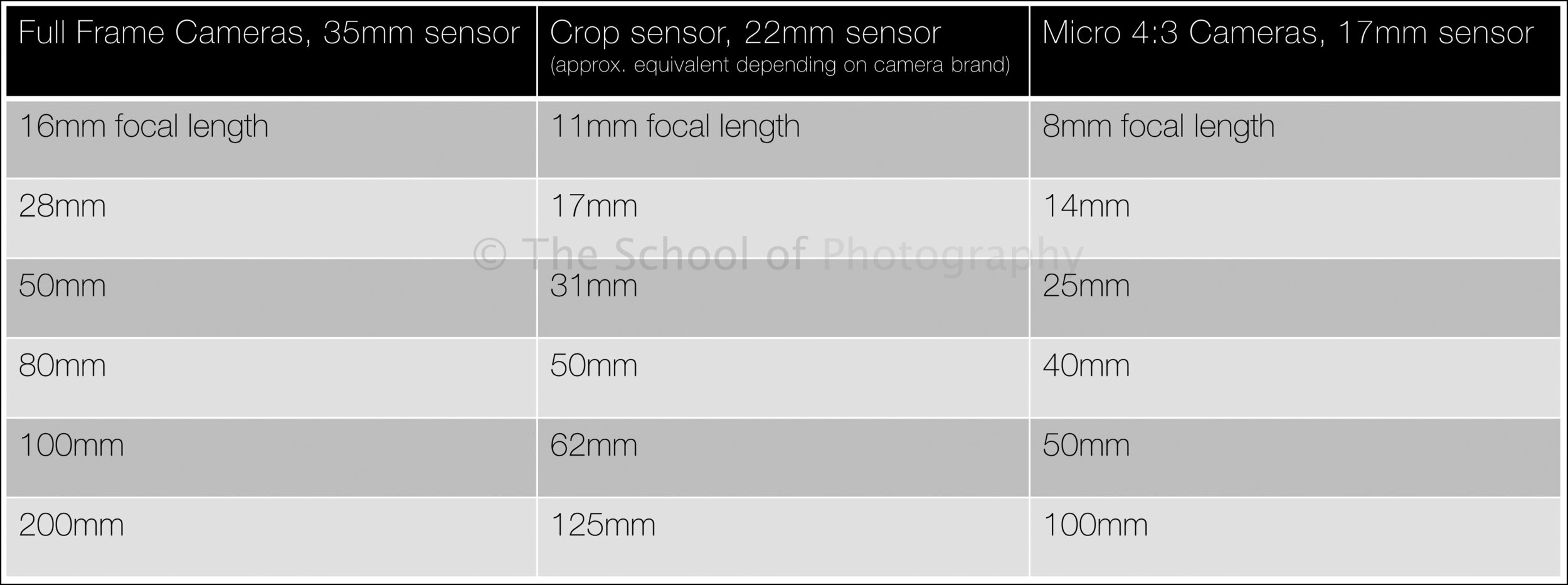
Camera sensor size comparison chart displaying equivalent focal lengths for full frame, APS-C (crop), and Micro Four Thirds camera sensors.
As shown in the camera sensor size comparison chart above, you need to zoom out on smaller sensors to achieve the same visual effect in your photograph.
For example, if you’re shooting at 35mm on a full frame camera and then switch to an APS-C (crop sensor) camera, you would need to zoom out to approximately 22mm to achieve an equivalent field of view.
Let’s look at a visual example of this difference in the images below.
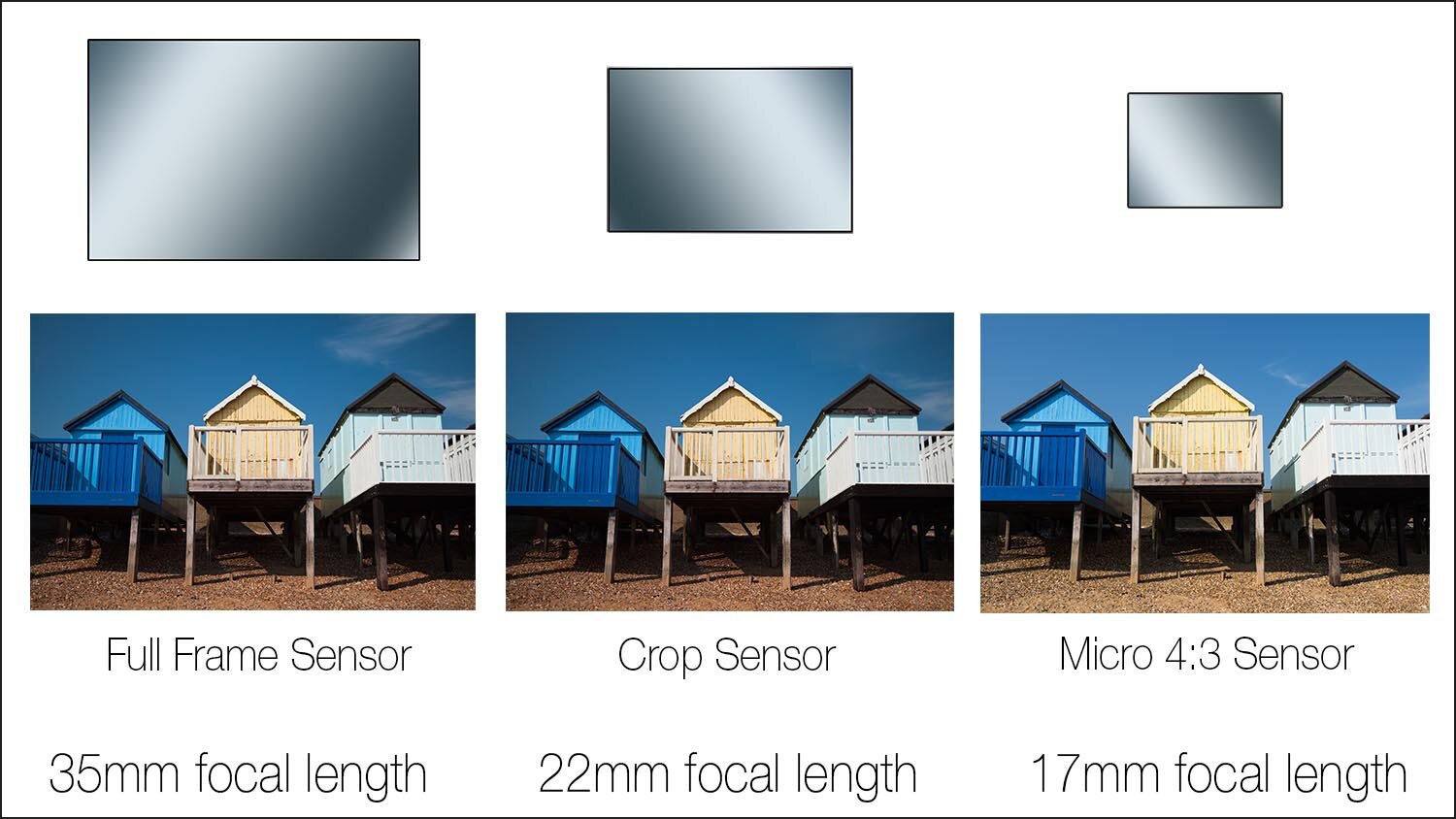
Sensor size comparison using equivalent focal lengths: full frame at 35mm, APS-C at 22mm, and Micro Four Thirds at 17mm, all producing a similar field of view.
Above is a camera sensor size comparison showing three images taken from exactly the same position, using different camera sensor sizes. As the sensor size decreases, the focal length must also decrease to maintain the same field of view — and this is what creates the equivalent visual effect.
It really is that simple: to achieve the same visual result when moving from a larger sensor to a smaller one, you just need to zoom out slightly. For precise matching, use the camera sensor size comparison chart above.
You can also download the chart as a PDF using the form below, making it easy to keep in your camera bag and refer to whenever you need it.
For a deeper understanding of focal lengths and which lenses to use in photography, click here.
Pros and Cons of Using a Camera Sensor Size Chart
Full Frame Sensors (Sensor Size Chart Insights)
Pros of Larger Camera Sensors
More image detail
Larger sensors can capture more detail, which becomes especially noticeable when printing very large images or doing high-end retouching and digital manipulation.Better low-light performance
Bigger sensors generally have larger pixels, allowing each pixel to capture more light. This results in less noise at higher ISO settings. (To learn more about ISO and image noise, click here.)
Cons of Larger Camera Sensors
Bigger camera bodies and lenses
Full frame camera systems are significantly larger and heavier. A larger sensor means a bigger camera body, larger lenses, and often a heavier tripod. Carrying a full frame camera with multiple lenses quickly makes the weight difference very noticeable.Higher cost
Full frame cameras tend to be more expensive, and the lenses and accessories designed for them usually cost more as well. It’s important to factor the total system cost into your decision.
APS-C vs Micro Four Thirds Sensor Size Comparison
Pros of Smaller Camera Sensor Systems
Smaller, lighter kit
Compared to full frame systems, smaller sensor cameras are much more compact and lightweight — particularly Micro Four Thirds systems. If you want a portable setup with smaller lenses and a lighter tripod, this is often the most practical choice.More affordable options
In general, cameras with smaller sensors are more affordable, with APS-C (crop sensor) systems offering excellent value. APS-C is the most common sensor format, which means strong competition between brands and plenty of budget-friendly options. Starter camera kits from major manufacturers are often the most cost-effective way to begin.And remember — it’s not about what gear you own, but how you use it. You don’t need to spend a fortune to take great photos.
Cons of Smaller Camera Sensor Systems
Lower image quality than full frame (in some situations)
APS-C and Micro Four Thirds sensors generally don’t match full frame sensors in absolute image quality, but that doesn’t mean they produce low-quality images. Modern cameras across all sensor sizes are capable of delivering excellent results. Below, you can see real-world examples comparing photos taken with full frame and Micro Four Thirds sensors.More noise at higher ISO settings
Smaller camera sensors tend to show more image noise at higher ISO values, particularly in low-light conditions. This is one of the main technical differences you’ll notice when comparing sensor sizes.
A camera sensor size chart helps put these differences into perspective, allowing you to compare formats objectively rather than relying on marketing claims.
Choosing the Right Camera Sensor Size (Using a Sensor Size Chart)

London at night photographed using a Micro Four Thirds sensor, demonstrating image quality and low-light performance.

London at night photographed using a full frame sensor, demonstrating image quality and low-light performance.
Can you spot the difference? Ultimately, the right choice comes down to how you plan to use your camera.
Ask yourself a few simple questions:
Will you be making large prints? Do you plan to retouch or heavily manipulate your images? What’s your budget? And how much equipment do you want to carry with you?
Once you’ve answered those questions, you can choose a camera system that fits your needs. As mentioned earlier, it’s not about what gear you own — it’s how you use it. A skilled photographer can create great images with any camera. For proof of this, click here.
Take your photography to the next level by becoming a member of TSoP
Like this? - Check out free tutorials below


I hope you liked this Camera Sensor Size Comparison, please leave us a comment and support us by sharing it with your friends and subscribe to our newsletter at the bottom of this page for more.
We also have an excellent learning community on social media so please join us there as well.
Thanks for watching and remember – Learn more at The School of Photography.
